
1. Tag and chip
An RFID tag contains an antenna and a chip. Passive tags do not carry their own battery; they are powered by the electromagnetic field from the reader. Active or semi-active tags may include battery support.
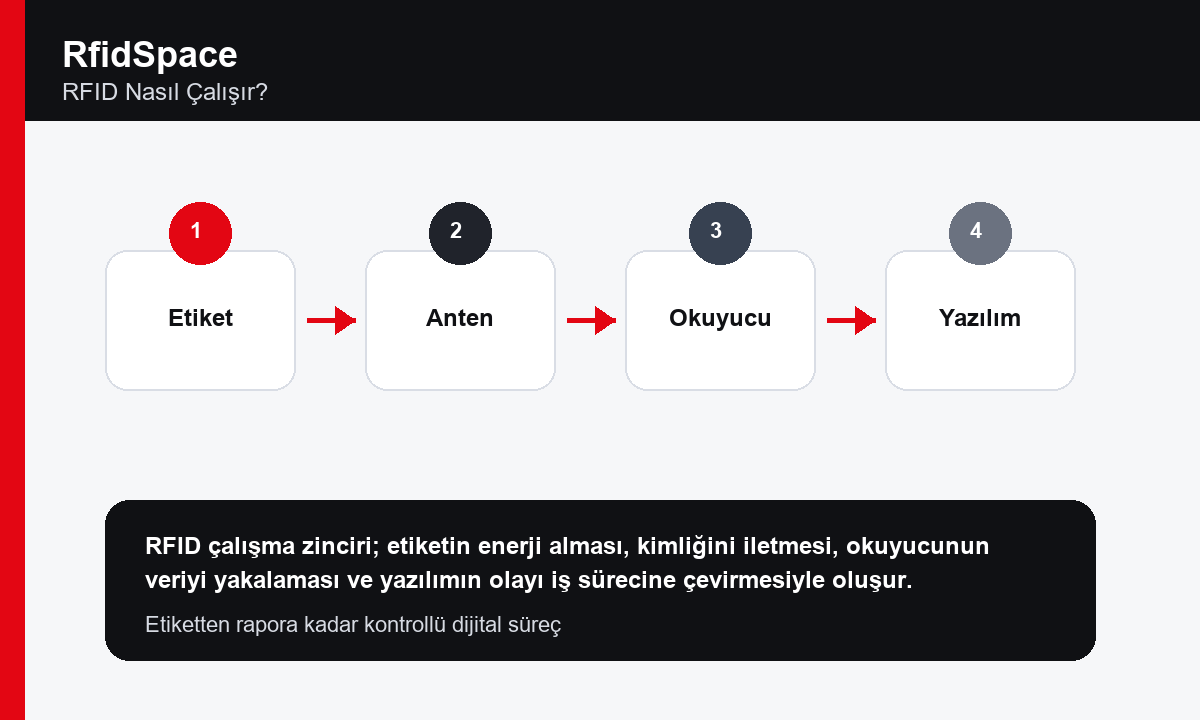
The RFID workflow starts when a tag is energized, sends its identity, the reader captures it, and software converts it into a business event.
RFID moves operational data from manual entry into real-time tracking, validation and reporting layers.
An RFID tag contains an antenna and a chip. Passive tags do not carry their own battery; they are powered by the electromagnetic field from the reader. Active or semi-active tags may include battery support.
The reader produces the RF signal and the antenna distributes it into the read zone. Antenna angle, power level, polarization and nearby metal or liquids affect read performance.
A read EPC is not enough by itself. Software maps it to a product, serial number, asset, carton, pallet, employee or location record.
The same tag can be read many times per second. Middleware or application logic filters duplicates, adds direction and location context, and creates receiving, counting, dispatch or alarm events.
Finally, read data is transferred to ERP, WMS, POS, PDKS or reporting systems. Physical movement becomes a digital record.
The right RFID architecture depends on tag type, read distance, environment, quantity, integration and workflow goals.