RFID Guide

What is RFID?

Learn what RFID is, how it works, business benefits and the main differences between RFID and barcodes.

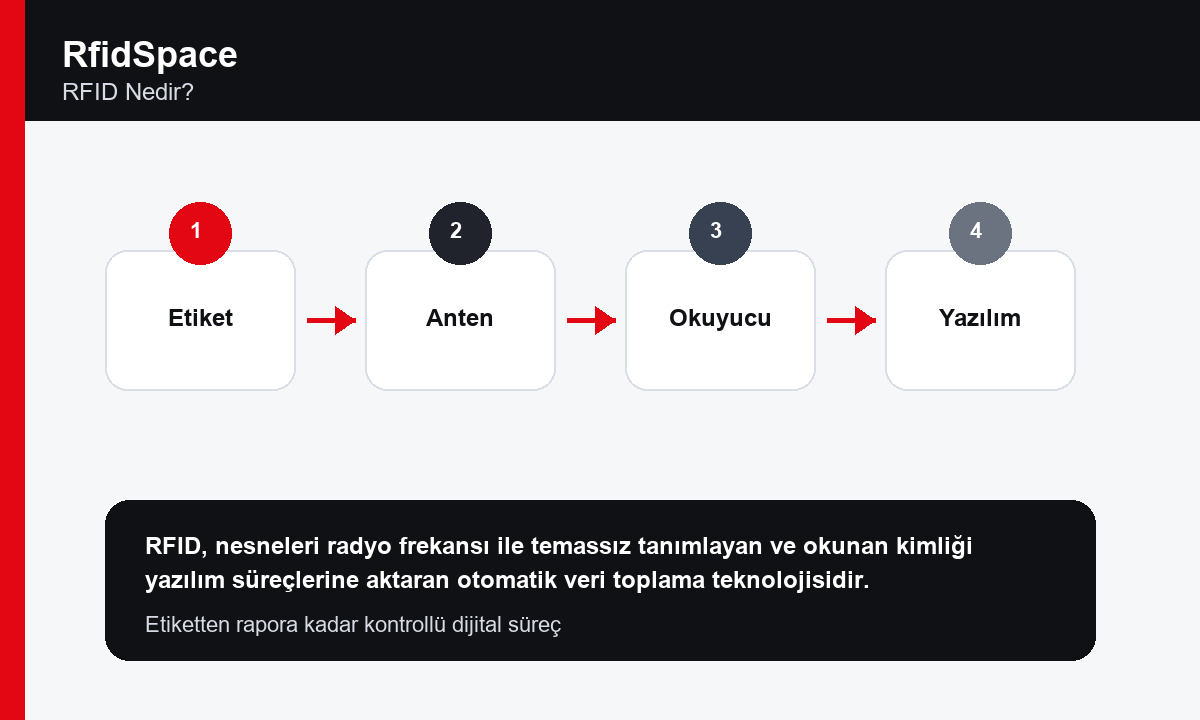
What is RFID? educational visual - RfidSpace

RFID is an automatic data capture technology that identifies items wirelessly and turns reads into software events.

RFID moves operational data from manual entry into real-time tracking, validation and reporting layers.

Core RFID logic

In an RFID system, each item, carton, pallet, asset, card or piece of equipment carries a unique identity. A reader antenna sends a radio signal, the tag responds, and the software matches that identity with stock, location, document or user records.

RFID is more than reading tags

In enterprise use, the value is not only the read itself but how the read is connected to a workflow. Receiving can compare expected items with read EPCs, counting can find shortages, dispatch can validate gates, and assets can gain assignment and location history.

RfidSpace approach

RfidSpace interprets RFID, barcode, BLE, RTLS, PDKS, ESL and IoT events in a shared operational model and turns reads into reports, alerts, integrations and decision support.
Subpages

How Does RFID Work?

See how reader, antenna, tag, EPC and software layers work together.

View

What Are RFID Benefits?

Review gains in accuracy, speed, traceability, error reduction and operational control.

View

Barcode vs RFID

Compare one-by-one scanning with bulk and contactless reading.

View

Project fit

The right RFID architecture depends on tag type, read distance, environment, quantity, integration and workflow goals.

Request Demo